
Mount Kailash: The Sacred Peak of the Himalayas
15 Nov 2024 Bishal Rijal

Smiling furtively from the far-flung western corner of Tibet, Mount Kailash in Himalayas has gained a reputation as one of the most sacred and breathtakingly beautiful peaks in the world. It is dubbed the “Abode of Lord Shiva” and believed to be a spiritual center by many religions. Mount Kailash is not just a place of pilgrimage but a mystery that beckons adventurers, trekkers, and spiritual seekers alike. We are going to delve deep in this comprehensive guide into the mystique of Mount Kailash, its religious significance, the climbing challenges, and how you can embark on this life-changing journey.
Where is Mount Kailash Located?
Mount Kailash is part of the Transhimalaya in the Ngari region of Tibet, standing tall at 6,638 meters (21,778 feet). Though not one of the highest peaks in the Himalayas, it commands immense respect and reverence. The mountain is situated near the source of four of Asia’s most prominent rivers: the Indus, Sutlej, Brahmaputra, and Karnali. You can visualize satellite map Here.
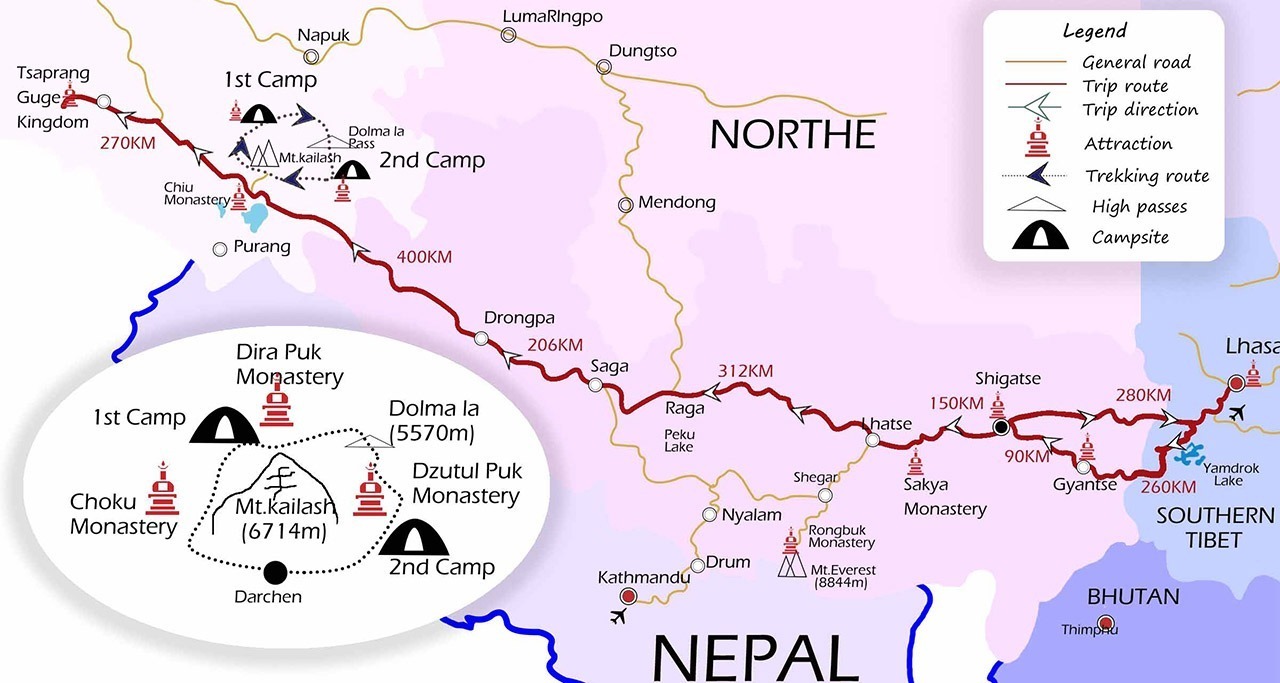
For many, visiting Mount Kailash is both a geographical and spiritual journey. Pilgrims believe that circumambulating the mountain—a tradition known as the “Kora”—can cleanse one’s sins and bring enlightenment.
Religious and Cultural Significance of Mount Kailash

Mount Kailash holds a unique place in the hearts of Hindus, Buddhists, Jains, and Bon practitioners. For Hindus, it is believed to be the residence of Lord Shiva, where he sits in eternal meditation with his consort Parvati. Buddhists revere it as the home of Buddha Demchok, a deity representing supreme bliss indeed. Jains recognize it as the site where their first Tirthankara attained liberation. While Bon, the indigenous religion of Tibet, believes it to be the axis of the world and the source of all spiritual power.
This makes Mount Kailash not just a physical destination but a spiritual one, drawing thousands of pilgrims from across the world every year.
The Ultimate Pilgrimage: The Kailash Kora
One of the most significant rituals for pilgrims visiting Mount Kailash is the 52-kilometer (32-mile) trek, known as the Kailash Kora. Completing this arduous journey is believed to absolve a lifetime of sins and grant spiritual merit.

The trek typically takes 3 days and crosses the Drolma-La Pass, which stands at 5,630 meters (18,471 feet). Despite the physical challenges, pilgrims from various religions consider the Kora a life-changing experience, deeply rooted in their spiritual beliefs.
For adventure seekers, the Kora presents an opportunity to experience the raw beauty of the Himalayas and deeply spiritual journey.
Adventure and Trekking Around Mount Kailash
Can You Climb Mount Kailash?
Unlike other peaks in the Himalayas, Mount Kailash has never been climbed, and it is unlikely it ever will be. Both religious traditions and governmental policies in Tibet prohibit climbing the mountain, as it is considered a sacred space, too holy to be touched by human feet. Although, Numerous attempts in the past have been met with failure. It is not just due to physical challenges but also divine or bureaucratic intervention.

For those with a thirst for adventure, the focus shifts from summiting Kailash to trekking around it or nearby peaks. The trekking circuit offers stunning views of Kailash, and the challenging terrain provides ample thrill for those looking to push their limits.
Best Time for the Mount Kailash Trek
The ideal time for trekking around Mount Kailash is between May and September, when the weather is relatively mild. Outside these months, the region is often covered in snow, making the trails impassable.
Traveling to Mount Kailash: Practical Tips for Your Journey

While reaching Mount Kailash is no easy feat, the journey itself is as rewarding as the destination. Here’s what you need to know:
How to Get to Mount Kailash
- Via Kathmandu, Nepal: Most travelers choose to begin their journey in Kathmandu, Nepal, where they can obtain the necessary permits to travel into Tibet. The overland journey from Kathmandu to Mount Kailash via the Gyirong Pass takes several days and offers breathtaking views of the Himalayas along the way.
- Via Lhasa, Tibet: An alternative route is to fly to Lhasa, the capital of Tibet, and then continue overland to Mount Kailash. This option offers more modern amenities along the way, it requires acclimatization to the high altitudes.
Permits and Documentation
Foreign travelers must acquire a Tibet Travel Permit and an Alien Travel Permit to visit Mount Kailash. It’s highly recommended to book your trip through a reputable travel agency, which can assist with obtaining these documents.
The Mysteries of Mount Kailash: Myths and Legends
Mount Kailash isn’t just a geographical wonder; it’s steeped in myth and legend. One of the most intriguing aspects is the belief that no human can climb the mountain. It’s said that those who attempt it are met with supernatural forces preventing their ascent. Therefore many believe that touching the summit would disrupt the divine balance of the universe.

Additionally, Mount Kailash is often referred to as the “Center of the Universe.” Ancient cosmologies in several cultures describe the mountain as the axis mundi, the central point that connects the heavens, the earth, and the underworld. This theory is further supported by the mountain’s symmetrical shape, which many claim resembles a giant mandala, symbolizing the spiritual journey of life itself.
What Lies Inside Mount Kailash? The Mystery Unfolds
One of the most tantalizing mysteries surrounding Mount Kailash is the question: what lies inside? Some believe that the mountain is hollow, housing ancient relics or even an extraterrestrial civilization. Others see it as a portal to higher dimensions, a gateway to enlightenment.

While there’s no scientific proof to back these claims, they add an extra layer of intrigue to an already mystical destination. Whether you view these stories as fact or fiction, one thing is certain: Mount Kailash has a powerful pull on the human imagination.
Plan Your Mount Kailash Journey with Us
At Nepal Everest Holidays, we offer guided tours that take you through the breathtaking landscapes surrounding Mount Kailash. Whether you’re seeking spiritual fulfillment or a thrilling adventure, our expert guides will ensure you have an unforgettable experience. From arranging travel permits to guiding you on the challenging Kailash Kora, we handle every detail to make your journey as smooth as possible.
Ready to take the first step on your journey to Mount Kailash? Contact us today to explore our exclusive packages and start planning your adventure.
FAQs About Mount Kailash
1. Is it possible to climb Mount Kailash? No, climbing Mount Kailash is prohibited due to its religious significance. However, you can trek around the mountain on the Kailash Kora.
2. How difficult is the Kailash Kora? The Kailash Kora is considered moderately difficult. The high altitude and unpredictable weather can make the trek challenging, especially for those without prior experience in high-altitude trekking.
3. What is the best time to visit Mount Kailash? The best time to visit Mount Kailash is between May and September when the weather is more favorable for trekking.
4. Do I need a special permit to visit Mount Kailash? Yes, foreign travelers need a Tibet Travel Permit and an Alien Travel Permit to visit Mount Kailash. We can help arrange these for you.